
Do you ever feel guilty about not spending enough time with your dog? Or maybe you want a dog but worry you won’t have enough time to train them or give them a meaningful life. I’m here to tell you this: you’re doing just fine. If you love your dog and do the best you can, your dog is living their best life.
Below is a little backstory on how I made it work as a single dog parent while working full-time in an office—and how you can, too.
When I got my first dog, Remi, I was living alone in Milwaukee with no friends or family nearby to help. I knew getting a puppy while working a full-time office job would be hard, but I also knew I was capable.
To make matters more interesting, I got Remi at the beginning of winter—while living in a second-floor apartment. That meant bundling up and carrying her up and down the stairs every hour for potty breaks. It wasn’t easy, but it was worth it.
Here’s what a normal weekday looked like for me and Remi when she was a puppy:
- 6:00 a.m. – Wake up, bathroom break, and playtime. We aimed for at least 30 minutes outside, weather permitting. If it was too cold, we played indoors.
- 6:30 a.m. – Feed Remi, then get myself ready for work.
- 7:15 a.m. – Another bathroom break (15–20 minutes).
- 7:40 a.m. – Remi goes in her kennel, and I leave for work.
- 12:00–1:00 p.m. – Drive home on my lunch break (I lived about 15 minutes away) to let Remi potty and play for about 10 minutes.
- 5:20 p.m. – Get home from work and do a walk and play session (45–60 minutes).
- 6:00 p.m. – Dinner for Remi, then dinner for me.
- 6:15–10:00 p.m. – Dinner, TV, playtime, and bathroom breaks as needed until bedtime.
Let’s talk about kennel time, because it’s okay.
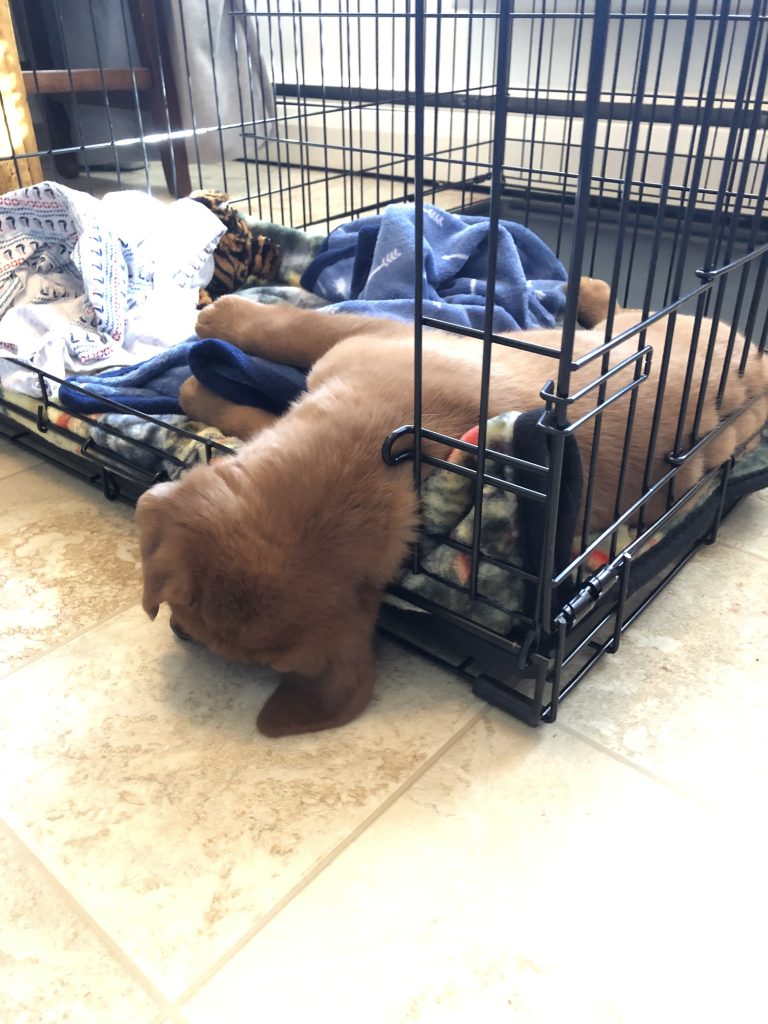
You might be thinking Remi spent a lot of time in her kennel—and you’d be right. On workdays, she was kenneled for 7–8 hours. But here’s the thing: she slept most of that time.
I made sure she got plenty of physical and mental exercise before and after work so she was relaxed rather than anxious or bored. Within two months, Remi was a kennel pro.
Was it busy and stressful? Absolutely. But it worked! I was also lucky to have a supervisor who allowed me to work from home 1–2 days a week during the first few months to help establish training. On other days, I hired a dog walker once or twice a week so I didn’t have to drive home every lunch break. Whatever the obstacle, you will find a way to make it work.
How Much Exercise Does a Dog Need When You Work Full-Time?
These are general recommendations based on my experience. Every dog is different, and needs will vary by age, breed, and energy level.
Aim for 3–4 Walks Per Week
Walks don’t have to be long. Even 10–15 minutes can do wonders—especially if you let your dog sniff as much as they want.
In the summer, I walk my dogs way more (about 5–7 times per week). In the winter, I do maybe 1–2 walks per week, depending on the weather. I’m a warm-weather gal living in a cold climate, so I do what I can.
Plan 1–2 Longer Activities Per Month
Try to schedule a 1–2 hour adventure twice a month. I choose to do them on the weekends since those are my days off. In the warmer months, I’ll go to new parks, trails or forest preserves and take long walks. In the colder months, I’ll visit dog-friendly stores such or Home Depot or the local pet store for indoor walks and sniffs
And yes—these adventures usually start or end with a Starbucks visit for a latte and pup cups. A little treat-yourself for you and the dogs!
Add Mental Enrichment 1–2 Times Per Week
Mental stimulation for dogs is just as important as physical exercise—and often easier to fit into a busy schedule. Mental enrichment can include:
- Training sessions
- Treat-filled Kongs
- Lick mats and snuffle mats
- Games such as Hide and Seek
These activities require minimal time and resources but can tire your dog out just as much as a long walk. Check out my enrichment post for more detailed ideas.
A Final Reminder for Working Dog Parents
I promise you this: whatever setup, space, and time you give your dog is better than a day spent in a shelter.
After volunteering in a shelter for over a year, I’ve seen dogs with gentle spirits become anxious or reactive simply because of the stressful environment. A quiet kennel in a loving home for eight hours a day is far better than even one day in a shelter.
You’re doing your best—and that’s more than enough!
Leave a Reply